


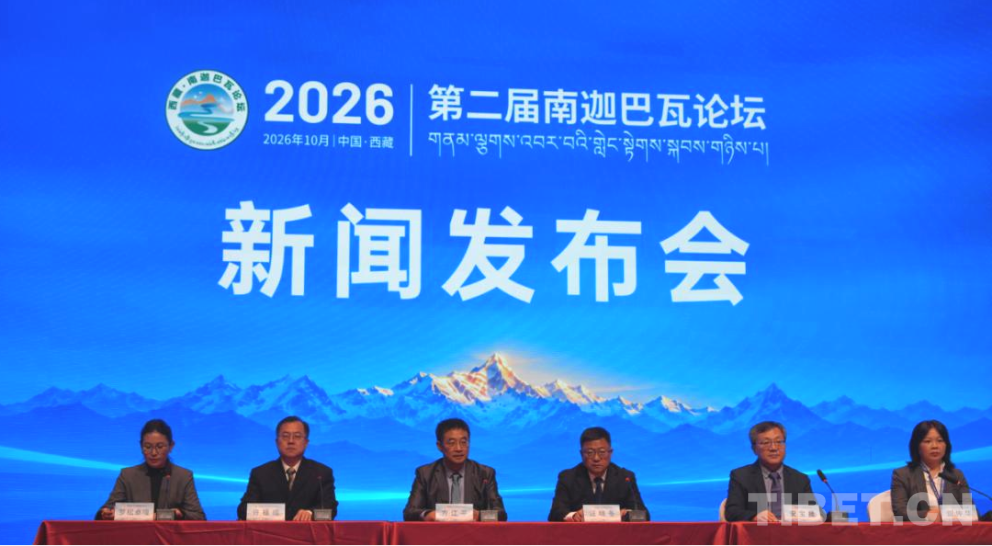
On the evening of October 10, a press conference was held to announce five key outcomes of the Second Namcha Barwa Forum on building a national ecological civilization highland in Xizang.
First, a set of constructive recommendations was developed. Experts from participating teams shared forward-looking, strategic, comprehensive and innovative insights on topics including environmental transitions on the Qinghai-Xizang Plateau and the adaptation of ecological conservation, climate change-related disaster risks and their prevention and control, the impacts of climate change on periglacial ecosystems and biodiversity, and exposure to the plateau environment and associated population health risks. Their work resulted in a set of constructive recommendations.
Second, the Assessment Report on Xizang Autonomous Region’s Efforts to Build a National Ecological Civilization Highland during the 14th Five-Year Plan Period was released. The report systematically reviews progress in six areas, namely establishing Xizang as a strategic area for safeguarding the national ecological security barrier, promoting harmonious coexistence between humanity and nature, piloting green development, serving as a model for nature conservation, pioneering efforts to improve people’s livelihoods through ecological progress, and improving the modern environmental governance system.
Third, the Second Qinghai-Xizang Plateau Scientific Expedition and Research revealed that the Qinghai-Xizang Plateau is undergoing its third environmental transition. Integrated results have been achieved in areas including climate change, ecological conservation, and disaster prevention and mitigation. The expedition has proposed science-based actions guided by a new ecological worldview, a new environmental security outlook, and a new vision for livable development, providing comprehensive scientific and technological support for Xizang’s efforts to build a national ecological civilization highland and promote green and livable development.
Fourth, a proposal was put forward for a dedicated Namcha Barwa science and technology initiative. The organizing institutions, including the Institute of Tibetan Plateau Research of the Chinese Academy of Sciences (CAS), Institute of Mountain Hazards and Environment (IMHE), CAS, Chengdu, and other institutions, drew on their expertise as science and technology think tanks. Focusing on the most pressing and immediate needs in building an ecological civilization on the plateau, they developed well-founded proposals for major science and technology research tasks, with the aim of directing innovation resources toward priority areas for ecological conservation on the Qinghai-Xizang Plateau.
Fifth, consensus was reached with Qinghai, Sichuan, Yunnan and other provinces on coordinated ecological conservation across the plateau. The parties will actively explore new models for coordinated, multi-stakeholder governance and deepen practical cooperation in cross-regional law enforcement and oversight, cross-sector coordination, and the sharing of research findings. Through these efforts, they aim to pool resources and expertise to prevent and mitigate ecological security risks of all kinds across the plateau.
Editor:Bella Wu
