Panchen Rinpoche: Promoting Adaptation of Religion to Socialist Society, Contributing to Rejuvenation of Chinese Nation
The 14th National Committee of the Chinese People's Political Consultative Conference (CPPCC), China's top political advisory body, held the third plenary meeting of the ongoing annual session on March 8, during which members delivered speeches.
Panchen Erdeni Chos-kyi rGyal-po, a member of the Standing Committee of the National Committee of the Chinese People's Political Consultative Conference, vice president of the Buddhist Association of China, and president of the Xizang Branch of the Buddhist Association of China:
Fellow members, the topic of my speech is: vigorously promoting the adaptation of religion to socialist society and contributing to the rejuvenation of the Chinese nation.
Advancing the adaptation of religion to socialist society is the essential path for the sound continuity of religion in our country. From the perspective of inheritors and practitioners of Tibetan Buddhism, we deeply recognize that China’s prosperity and stability provide the fundamental guarantee for the healthy continuity of religion, and that the rejuvenation of the Chinese nation represents a shared well-being for all believers and non-believers alike.
In recent years, with the care and support of the Communist Party of China and the Chinese government, the Tibetan Buddhist community has actively explored ways to align with socialist society and has achieved positive results. The level of law-based and standardized management of monasteries has continued to improve. The interpretation of Buddhist teachings has kept pace with the times, and the system for cultivating monastic talents has become increasingly well-established. As an important component of China’s traditional culture, Tibetan Buddhism has been effectively preserved and developed through its inheritance. Furthermore, the national, civic and legal awareness of religious figures and believers has been significantly strengthened.
While recognizing our achievements, we should be keenly aware of challenges that confront us. First, it is necessary to integrate the core socialist values more systematically and deeply into the interpretation of Buddhist teachings, the dissemination of Dharma, and the practice of cultivation. Second, the system for cultivating religious talents needs further optimization. Third, efforts to fully leverage the positive role of religion in serving society and participating in public welfare and charitable undertakings require strengthening.
The fundamental guideline for addressing these issues lies in thoroughly studying, understanding, and implementing Xi Jinping Thought on Culture, the Party’s policies on the governance of Xizang in the new era, and Xi Jinping’s important thought on strengthening and improving ethnic work, his statements on religious affairs, and his instructions on Xizang-related work. Efforts should be coordinated across five dimensions, namely ideological guidance, rule-of-law practice, cultural integration, social service, and talent development.
The first is to strengthen ideological guidance and solidify the foundation of values. We should continue to carry out in-depth patriotism and socialist education within the religious community, integrating education on the sense of national identity, citizenship, and the rule of law into daily Dharma teachings, so that the recognition of the motherland, the Chinese nation, the Chinese culture, the leadership of the Communist Party of China, and socialism with Chinese characteristics can become a conscious pursuit among religious practitioners.
The second is to deepen rule-of-law practice and enhance governance effectiveness. Religious circles should take the lead in respecting, studying, observing, and applying the law, conducting activities, managing affairs, and handling relations in accordance with law. We should work in coordination with the government to raise the level of law-based governance of religious affairs, applying legal thinking and methods to resolve conflicts and issues in the religious field.
The third is to promote cultural integration and strengthen Chinese identity. We should adhere to strict governance of religious practice, actively forge a strong sense of community for the Chinese nation, and deeply explore teachings and regulations that are conducive to social harmony, progress, and healthy civilization. We should interpret doctrines and regulations in ways that align with the requirements of China’s contemporary development and the fine traditional Chinese culture.
The fourth is to expand social services and practice altruistic spirit. We should encourage the religious community to play an active role in cultural preservation, moral education, supporting the weak and needy, and public welfare and charitable undertakings, integrating the conscious practice of faith into the grand endeavor of Chinese modernization. We should guide monks, nuns, and believers to unify their religious practice with dedication to their work and contribution to society.
The fifth is to strengthen talent cultivation and ensure healthy inheritance. We should improve the training model that balances modern scripture study with traditional practice, enhance learning of the national standard spoken and written language, Chinese history, legal regulations, and modern scientific knowledge, and focus on nurturing a group of high-quality monastic talents in the new era who love both their country and their religion, maintain purity and harmony, and uphold correct belief and practice.
The rejuvenation of the Chinese nation is now on an irreversible historical course. This provides an unprecedentedly broad stage for the healthy inheritance of all religions and bestows a profound historical responsibility on the religious community. The Tibetan Buddhist community is determined, with a deep sense of gratitude to the motherland and all sentient beings, to more consciously integrate into the overall national development, striving to be steadfast practitioners of patriotism, faithful inheritors of fine traditional Chinese culture, and active contributors to Chinese modernization. With a more proactive stance, we will guide monks, nuns, and believers to work together with people of all ethnic groups across the country, and strive forward with one heart and mind. May prayer flags flutter for the prosperity and stability of the motherland, and may Buddhist chants resonate for ethnic unity and progress, contributing wisdom and strength to the realization of the rejuvenation of the Chinese nation. Tashi Delek!
Stories
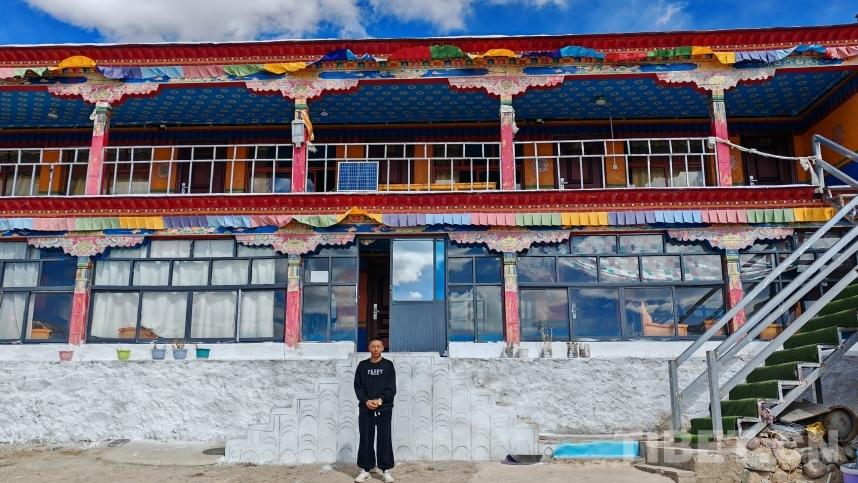
Path to Better Life for People in Ombu Community, Nagqu
Yomzhong, at the age of 26, runs his own homestay beside Tangra Yumco Lake.
Editor’s Choice
- Eurasia Review’s Veiled Attacks Fail to Conceal Its Arrogant Rhetoric
- The Dalai Lama's Grammy proves art is drowning in politics
- Foreign Media Outlets: The 14th Dalai Lama Was Named 169 Times in Epstein’s Emails
- The Authority of the Central Government on the Reincarnation of Living Buddhas is Unquestionable
- Stay Alert to Tomoya Obokata and Others Utilizing Position as UN High Commissioner for Human Rights to Stir Up Trouble