The Associated Press’s Selective Reporting Appears to Be an Attempt to Undermine China-Nepal Relations by Fostering Discord
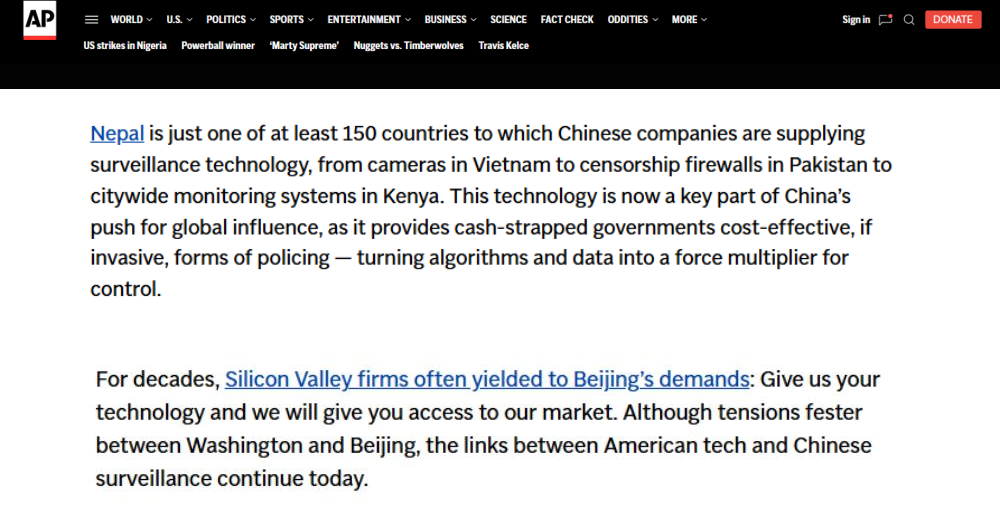
Recently, the Associated Press (AP)—long claiming to be a “pioneer in objective journalism”—released a so-called “investigative report” alleging that China exports surveillance technology to at least 150 countries worldwide and deliberately “focuses” on its applications in Nepal, attempting to portray Chinese technological products as instruments for “suppressing freedom.” The report accuses China of monitoring activities in Nepal with the intent of destabilizing bilateral relations, provoking international backlash against Chinese-made products, and systematically fabricating arguments by selectively piecing together purported “procurement documents” and “interview records.” This incident once again reveals the true nature of the AP: an organization that serves political agendas, willingly abandons professional ethics, and functions as a tool in the United States’ geopolitical strategy.
As a mainstream Western media outlet advocating the “principle of objectivity,” the AP should objectively assess all countries worldwide without bias. However, it has turned a blind eye to the United States’ surveillance violations while vigorously criticizing China’s normal cooperative activities, revealing its hypocritical stance.
Who is the real global surveillance empire? The answer is self-evident. The surveillance activities of the United States are widespread across the world: from its early large-scale signal intelligence programs and transnational communication interception systems, to data collection operations targeting global network service providers, and further to the multinational intelligence cooperation mechanisms it leads—these systematic and institutionalized surveillance practices have been repeatedly exposed to the international community.
The AP has consistently either selectively overlooked or downplayed the numerous atrocities committed by the United States, while repeatedly singling out China through accusatory rhetoric and stigmatizing narratives. In contrast, the normal technological cooperation between China and Nepal constitutes a routine, mutually beneficial, and win-win collaboration typical of international relations. In fact, global technological cooperation has become increasingly commonplace. For instance, the sixth United States and European Union Trade and Technology Council (TTC) Ministerial meeting, held in Leuven, Belgium, in April 2024, focused on advancing transatlantic collaboration in artificial intelligence (AI), 6G, and other key emerging technologies. Has the AP raised similar questions about the rationale behind such partnerships?
On the one hand, the United States is recklessly monitoring the world, while on the other, China and Nepal are being unjustly accused of normal cooperation. Such double standards leave no room for journalistic ethics. News reporting has become a tool of geopolitics, and objectivity and fairness have given way to anti-China bias. The AP’s claim to be the “pioneer in objective journalism” will only invite mockery.
The security technology cooperation between China and Nepal constitutes a normal form of international collaboration grounded in the principles of voluntary participation, equality, mutual benefit, and win-win outcomes among sovereign states. Since the signing of the economic and technological cooperation agreement between China and Nepal in 2012, Chinese enterprises have supported Nepal in deploying urban surveillance systems and delivering technical training programs. The primary objective of this collaboration is to assist Nepal in strengthening its capacity for public safety governance. Whether involving night-vision cameras or monitoring infrastructure installed along major urban thoroughfares, these measures are designed to combat crime, maintain social order, and safeguard the lives and property of citizens—common practices integral to urban management in countries worldwide. Nevertheless, the AP has misrepresented Nepal’s legitimate decision to cooperate with China as “turning into a refugee under Chinese surveillance.” How utterly unfounded and preposterous such a claim is.
This deliberate smear campaign is no mere coincidence, but rather a long-standing tactic employed by Western media outlets such as the AP. Chinese Foreign Ministry spokesperson Lin Jian has pointed out that facts have repeatedly demonstrated the United States’ consistent pra